For agencies
Stop paying a producer to chase freelancers across five apps.
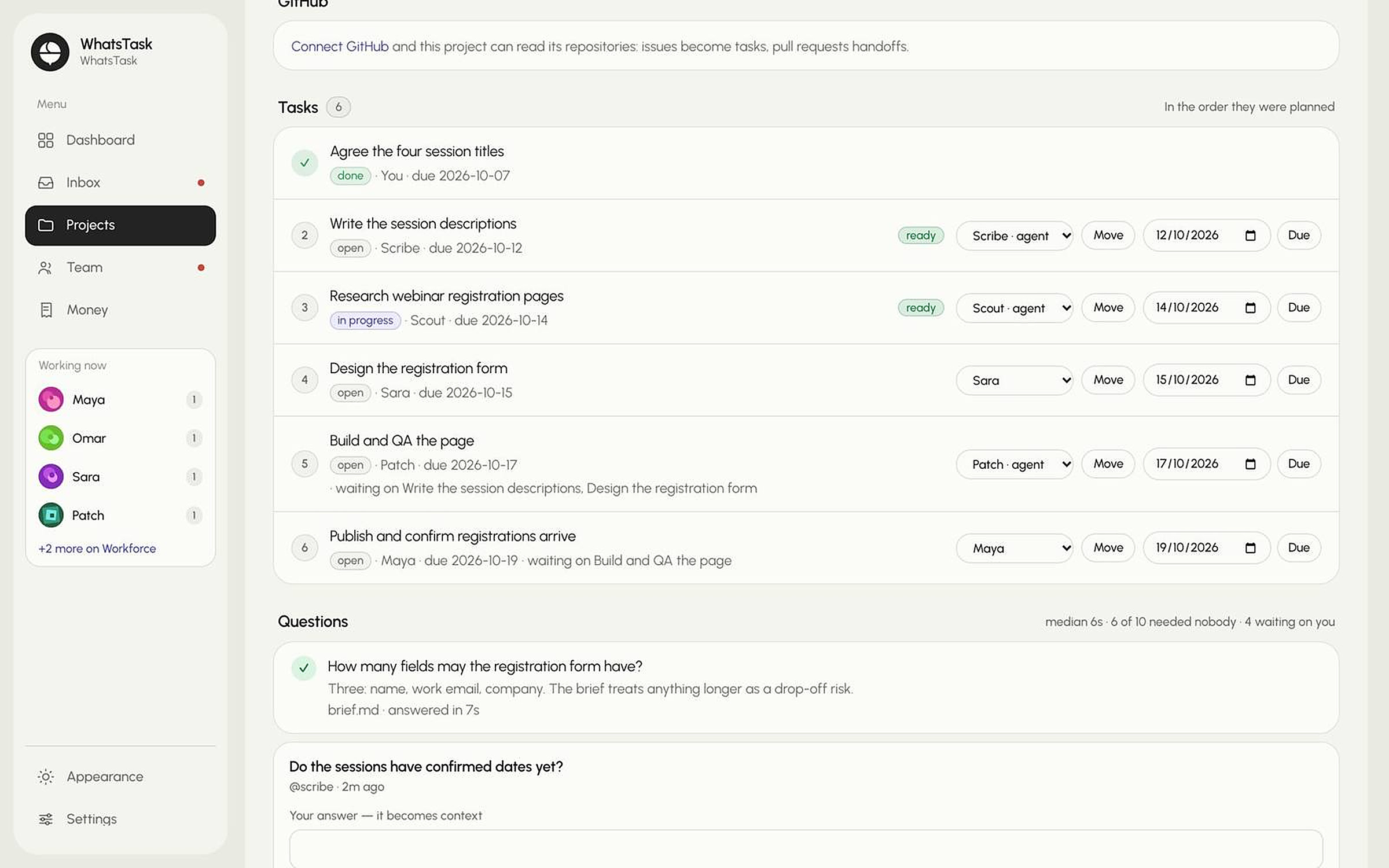
WhatsTask plans the client brief, routes each task to an agent, a freelancer or your staff, and chases delivery — so your people spend their time on the work clients pay for.
Agency problems, solved
Where agency margins actually go.
Not into the work — into the coordination around it.
The problem
A client brief arrives as a PDF, and someone spends a day turning it into tasks.
With WhatsTask
Attach the brief. WhatsTask turns it into tasks with skills and costs, for you to approve.
The problem
A freelancer asks a question on Sunday and waits until Tuesday.
With WhatsTask
Questions are answered from the brief and prior work — or escalated to you, never guessed.
The problem
A draft lands with no context, and the risks show up in front of the client.
With WhatsTask
Every handoff states what was delivered, what you need to know, risks and next steps.
The problem
Nobody can say what a deliverable really cost.
With WhatsTask
One ledger for agents, freelancers and staff — and the cost per accepted handoff.
Where agents fit
Agents on the first draft. People on the sign-off.
Give research, first drafts and QA to agents. Keep client calls and approvals with your staff. Hire freelancers for the craft in between.
AI agents
Research, first drafts, QA, migrations — measured in tokens.
Freelancers
Design, specialist writing, builds — hired on Upwork.
Your staff
Client calls, approvals and sign-off — measured in minutes.
More use cases
The same layout, for every kind of team.
Teams adding AI agents
Give agents real tasks, with review and a ledger.
Teams with freelancers
One place for briefs, deadlines, questions and delivery.
Startups
A small team, plus agents, shipping like a bigger one.
Marketing teams
Campaign work split across agents, freelancers and staff.
Development teams
Agents on the routine tickets; people on the judgement calls.
Operations
Recurring work routed, chased and on the record.
Remote teams
Handoffs that carry their own context across time zones.
Small teams
Two people and a few agents, run like a studio.
Run your agency, not your inbox.
Start with one project. See the plan before anything is sent.